Settlement History
The Founding of Waterford, Virginia in the Confederation Period (1784-1789)
Waterford, Loudoun County, Virginia

History of the founding of Waterford, Virginia, tracing how Quaker businessman Joseph Janney established the village in 1784 and how its early merchants, craftsmen, and religious community navigated the economic and political challenges of the post-Revolutionary Confederation period.
Joseph Janney, a local Quaker businessman, founded the village of Waterford in 1784, shortly after the Revolutionary War concluded. These were exciting times fraught with challenges as Virginia recovered from war and got its footing as part of an alliance with twelve other independent states. The new village of Waterford experienced all the ups and downs that occurred as politicians molded and remolded the United States of America.
Setting the Scene
The Revolutionary War ended with the signing of the Treaty of Paris in 1783 and it was time to get down to the business of building a new nation with economic growth and prosperity. After all, one of the causes of the war was Britain's Proclamation of 1763 that barred colonists from settling west of the Appalachian Mountains in territory reserved for Indigenous People. George Washington had acquired tens of thousands of acres in the Kanawha and Ohio River Valley, claiming the land as bounty lands after the French and Indian War, that could now be settled by European Americans.
But there were post-war challenges to overcome. Hard currency was scarce, paper money, printed during the war to pay war debts, wasn't worth much, and the loyalist Scottish merchants who dominated the economy of Alexandria before the war, had returned to Great Britain.

In 1781, by ratifying the Articles of Confederation, the thirteen American colonies banded together in a firm league of friendship, while remaining highly sovereign, independent states. The alliance left a weak central government that relied on states for funding and had no rights to enter into collective trade agreements.
Loudoun County was left in a bind. The British West Indies had been a primary trading partner for Loudoun County flour before the war, but after the war the ports were closed to American shipping except for a limited number of excluded items.1 Compounding international trade issues, each state established their own trade policies, which not only levied tariffs on merchants from other states, but weren't effective in coercing the British into opening up the West Indies trade.
Setting the stage for the future founding of Waterford, Joseph Janney purchased a 12-acre parcel in 1781, a pivotal year marked by the intensifying Virginia Campaign of the Revolutionary War.2 Janney was a successful businessman with a retail store and tannery in Leesburg.3 In 1784, he partnered with two men from Philadelphia to enter the merchant shipping business, helping to fill the void left by Scottish merchants. He received imports from London in the ship the Friends (a nod to the Quaker's Society of Friends) and sold a general assortment of merchandise to retail merchants, advertising that his prices were low since most goods were shipped by manufacturers.4 To facilitate the business, he moved to a lot he purchased in Alexandria.5 This move opened up an opportunity to develop his 12-acre Loudoun County parcel into a commercial and industrial village.
Village Formation
Driven by optimism, Joseph Janney devised a plan to establish a new village on his 12-acre tract, strategically positioned next to Mahlon Janney's operational grist mill and sawmill. The site was ideal, benefitting from the established road network created to provide farmers with access to the mills. A commercial and industrial village existed to serve the surrounding farming community, so placing it at the hub of a road network leading from all areas of the community made the location convenient for customers coming to the village for goods and services. Furthermore, the adjacent sawmill was a valuable asset, providing materials for new residents to construct their homes and shops.

The commercial foundation of Waterford was established in 1784 when Joseph Janney sold the first lot, which included a handsome stone house and stable, to Thomas Moore Jr. 6 Upon arriving in the village, the 24-year-old Moore became active in both commerce and the Quaker community, opening a store and serving as the clerk of the Fairfax Quaker Meeting.7 Like many other merchants in the region, Moore likely saw an immediate opportunity to profit from a substantial, pent-up consumer demand for British goods, which had been inaccessible throughout the Revolutionary War.

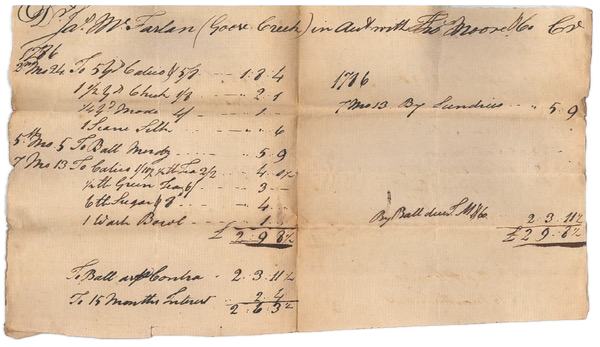
Most of the items Thomas Moore Jr. sold in his store were likely imported. Records show that he sold coffee, rum, shoes, buckles, fabrics of many types (silk, linen, osnaburg, calico, and more), knives, sugar, pepper, a handkerchief, a pocket book, green tea, a wash bowl, and a stove.

To finance his new venture, Moore borrowed £100 from John Sutton, an established merchant based in Alexandria and a fellow attendee of the Fairfax Quaker Meeting. 8 Moore used his house and lot as collateral on this loan. Sutton's importance stemmed not just from providing capital, but by also helping to fill the commercial void left by the departure of the Scottish merchants who had previously dominated the merchant trade in Virginia before the war. Sutton's business was focused on acquiring foreign imports; he advertised specifically that his goods were sourced directly from Britain and even hired ships to obtain them.9 This reliance on British imports was common, as most merchants advertising in the Alexandria, Virginia newspaper soon after the war boasted of having goods from Britain. Interestingly, the local newspaper typically dedicated a full page to news from London, suggesting that, despite the recent conflict, the local populace quickly resumed its economic and informational connections with Great Britain and did not harbor lingering commercial grudges against its former adversary.
Building upon his business experience, Joseph Janney continued to invest in the village's industrial development. Utilizing his prior knowledge from owning a tannery in nearby Leesburg, Janney established a tannery in Waterford. He subsequently leased this operation to James Moore, the brother of merchant Thomas Moore Jr., establishing a critical step in the local supply chain by turning raw hides into leather.10 Further expanding the leather-goods industry, James and Thomas's brother, Asa Moore, established a saddlery in Waterford.
To staff these interrelated operations, the Moore brothers relied heavily on apprentices bound out by the county court. Asa Moore, the saddler, was joined by 18-year-old Thomas Brown and 15-year-old John Hirst in 1785, both bound to learn the saddlery trade.11 The Moores later expanded their training commitment, taking on apprentices for the tanning and currying trades.12 Even ancillary services were supported by this system: 15-year-old John Evans was bound out in 1786 to learn the trade of a cabinet maker, a skill crucial for providing furnishings and fixtures for the growing village.13 The presence of these related trades demonstrated the growing economic sophistication of the village, creating a self-sufficient cluster of businesses that supplied essential goods to the surrounding agricultural community. It was the collective influence of the Moore family that led to the village being named Waterford, a tribute to their ancestral home in Waterford, Ireland.
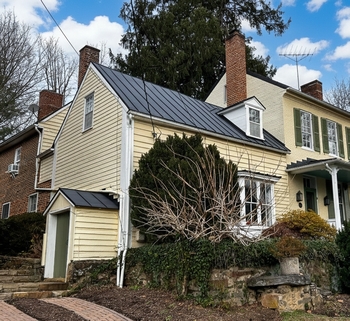
The establishment of the village was truly a family affair for the Moores. Joining the three brothers was their sister, Ann, and her husband, Evan Taylor. Taylor likely contributed to the growing village economy through the building trades, working as a carpenter.14 He leased a half-acre lot from Janney and constructed a house there.15 Although the specific location of his property within the village remains unknown, it is possible that he leased the lot adjacent to Thomas Moore Jr. and built the log house that remains today as part of a larger structure.
The presence of the entire Moore family, with their diverse skills in merchandising, tanning, saddlery, and carpentry, was foundational to the growth of Waterford as a self-sufficient commercial and industrial center.
Following the initial development by the Moore family, Joseph Janney continued to expand the village's settlement by selling and/or leasing four additional lots along the main road to Quaker brethren: Richard Richardson, Joseph Pierpoint, William Paxson, and Joseph Scott. Each of these individuals constructed a house on their property, signaling the community's physical growth.

A notable characteristic of the developing village of Waterford was the prevalent use of pauper apprentices: poor, young individuals bound out by the county court to learn trades. This practice was deeply intertwined with the Quaker community's critical moral duty to aid the impoverished, especially amid economic depression. Waterford's businessmen became instrumental in achieving these social objectives locally by actively utilizing apprentice agreements. These formal agreements ensured that poor youth received vocational training in the village's diverse trades, including blacksmithing, tanning, saddlery, and various manufacturing skills. This commitment to training proved essential: many of these former apprentices later became productive residents, establishing their own shops, which ultimately fueled the physical and economic expansion of Waterford during the post-war recovery. This local commitment to vocational training and social uplift is clearly illustrated by the lot holders who utilized the system. Of the new lot holders, Joseph Pierpoint and William Paxson conducted industrial trades crucial to the local economy and actively participated in the apprenticeship system.
Pierpoint bought his half-acre lot in 1785 and was a blacksmith, a profession essential for repairing and forging tools, maintaining wagons, and providing horseshoes.16 This trade was also particularly valuable for grist mills, which constantly required maintenance and repair of iron parts in their machinery. John Anderson was bound out to him when he was 17 years old to learn the trade of a blacksmith.17
By 1789, Paxson established his wire weaving business on a leased quarter-acre lot. His advertisements for items like Rolling screens, and all kinds of Fan Riddles, Shaking Screens, &c. clearly demonstrate a direct association with the local agricultural processing industry, as these tools were essential for cleaning and separating grain before milling.18 Paxson further solidified his industrial role by also being a wheelwright, linking his work to transportation and farming technology. His operation required significant labor: John Fisher was living with Paxson in 1789 and was likely employed by him.19 The business was robust enough to take on Amos Pyott, an 18-year-old bound out to Paxson by the county court specifically to learn the dual trades of Wheelwright and fanmaker.20
The remaining lot holders had less clear connections to the village's trade economy. Richard Richardson, who purchased his half-acre lot in 1785, was a non-resident who did not live in the village, making his specific use of the property unknown.21 Similarly, Joseph Scott, who leased his quarter-acre lot, has an unknown occupation.22 His log house, constructed ca. 1785, survives today.
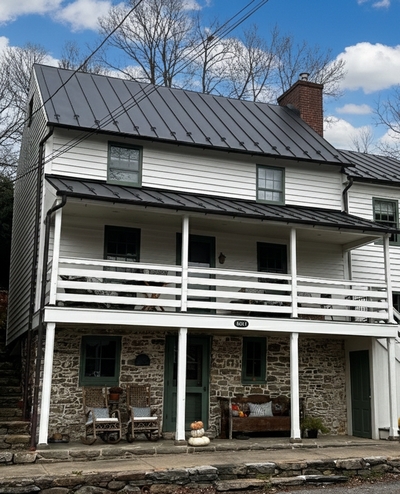
It is possible that Evan Taylor, the village carpenter and brother-in-law of the Moore brothers, either worked on the construction of the house or supplied furniture.23
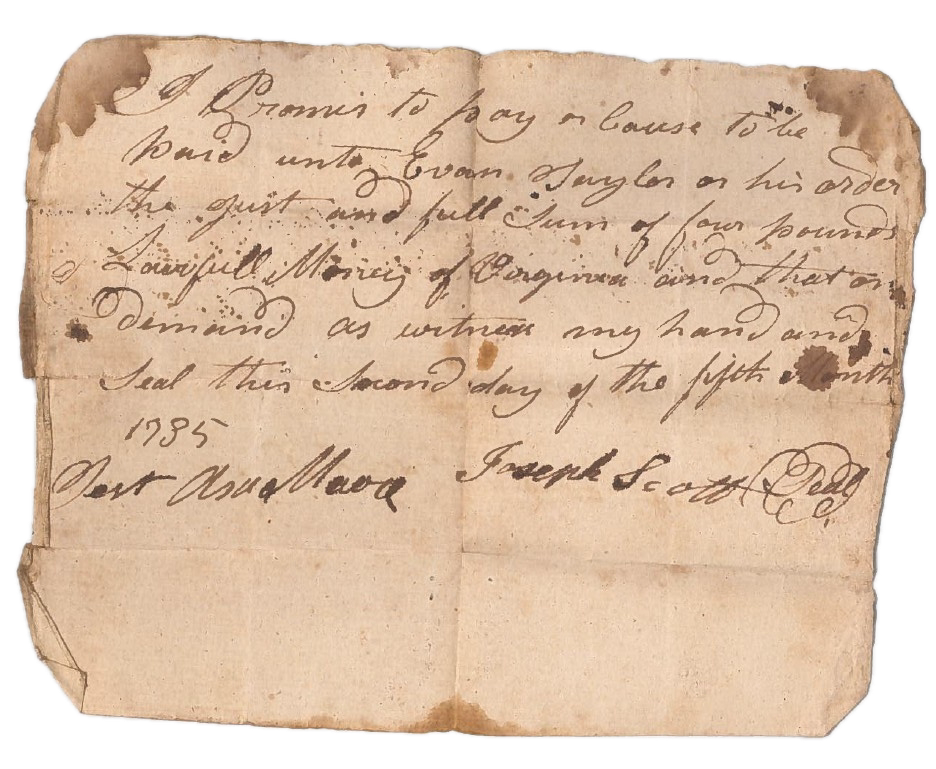
Nevertheless, the settlement of these four lots by Quaker brethren demonstrated Janney's efforts to build a stable community along the road, one supported by the foundational trades of the Moore brothers and the new influx of craftsmen like the blacksmith Pierpoint and the industrial screen-maker and wheelwright Paxson. These individuals collectively represent the village's early industrial diversity and reliance on the agricultural economy.
The village's growing commercial vitality soon attracted competition. William Hough opened his own mercantile establishment around 1787.24 This store was housed in what became known as Hough's red stone store house and was strategically located near the existing general store operated by Thomas Moore Jr.25 The opening of Hough's establishment provided the community and surrounding farmers with an alternative source for goods and supplies, signifying the village's increasing importance as a local retail center and further solidifying its economic base in the years immediately following the Revolutionary War.
As the village developed, the county levied taxes based on the assessed rental value of each lot, a measure instigated to help repay Virginia's Revolutionary War debt. This revenue generation immediately created a dilemma for the local Quaker community, who were pacifists. In 1784, attendees of the Fairfax Meeting debated whether paying a land tax designed to finance past military debt was permissible. Ultimately, a committee decided that Friends were at liberty to use their own judgment regarding payment.26 Crucially, these same land tax records are vital for understanding Waterford's early formation and growth, particularly for leased lots which were not recorded in deed books.27 It is through these records that historians can conclusively demonstrate that no village existed at the site prior to Waterford's establishment.

As the village's industrial base and local economy were being physically established, a monumental shift in Virginia law was simultaneously providing the legal and political stability necessary for this community of dissenters to thrive: the establishment of true religious liberty.
Religious Liberty and the Local Quaker Community
As the new village of Waterford was taking shape through Quaker investment and industrial development, Virginia was simultaneously undertaking a fundamental shift in its legal and political landscape: the establishment of true religious liberty. The political transformation in Virginia following the Revolutionary War had a profound impact on the local Quaker community, ushering in an era of greater religious freedom and civil recognition. The most substantial change was the end of government-mandated church support, a central issue for the Society of Friends.

Memorial and Remembrance Petition
Courtesy Library of Virginia

The drive toward true religious freedom faced a major challenge in 1784 with the introduction of Patrick Henry's General Assessment Bill.28 The bill's purpose was to levy a general tax on all citizens to provide financial support for Christian teachers and ministers, regardless of their specific denomination. Many, including dissenters like the Quakers, vehemently opposed the bill, viewing it as a thinly veiled attempt to re-establish state-mandated religion. In response, James Madison authored the influential Memorial and Remonstrance Against Religious Assessments, which was circulated across the state, sparking a massive wave of public petitions. This organized opposition successfully demonstrated to the legislature the deep popular resistance to the bill. Notably, two Waterford villagers, Asa Moore and Joseph Janney, signed the petition, formally aligning the community with the movement for disestablishment.29 The massive public backlash ultimately ensured the bill's defeat and provided the political momentum for the subsequent passage of permanent religious protections.
The culmination of this movement was the passage of Thomas Jefferson's Statute for Religious Freedom in 1786.30 This landmark legislation completely dismantled the Anglican Church's established status, declaring that no individual could be compelled to support any religious worship or ministry whatsoever, thus ending religious taxes. For Quakers, who had historically refused to pay these levies on conscientious grounds, this act was a fundamental victory, securing their economic and religious liberty.
Beyond the abolition of religious taxation, the state granted dissenting faiths, including the Society of Friends, full legal standing for their religious practices. A key reform was the 1785 An Act Concerning Marriages, which formally empowered Quaker ministers to conduct marriages that were fully recognized by the state.31 Prior to this, only Anglican ministers could perform legally valid marriages without special dispensation. This act validated Quaker internal practices, elevating their ceremonies to the same legal standing as any other, removing a legal complication for Friends couples. Collectively, these legislative actions transformed the relationship between the state and the Society of Friends, replacing decades of religious tension and penalties with a foundation of civil rights and enshrined freedom of conscience.
Area Infrastructure Improvements
With the legal status of the Quaker community firmly established by landmark state legislation and the burdensome system of religious taxation abolished, the villagers of Waterford could turn their full attention to commercial and industrial ventures. While the new laws provided the civil security necessary for the community to operate, the economic prosperity of Waterford, dependent on its millers and tradesmen, ultimately relied on efficient connections to the major port of Alexandria. While the village itself did not initiate regional planning, Waterford and its surrounding agricultural community stood to greatly benefit from efforts made soon after the village was formed to improve area infrastructure.
Infrastructure improvements were a primary focus in the region surrounding Waterford soon after the conclusion of the Revolutionary War, reflecting a collective effort to boost economic prosperity and efficiency. To facilitate the movement of vital agricultural goods to port, significant steps were taken to upgrade the area's main transportation corridors. A crucial development occurred in 1785 when the Main Road from Vestal's Gap to Alexandria was officially designated as a toll road.32 This decision was essential for generating the funds necessary to finance the substantial repair and straightening required for this heavily traveled route, which follows much of present-day Route 9 and Route 7. By converting the road into a self-sustaining turnpike, the heavy burden of maintenance was lifted from the shoulders of the bordering farmers, allowing them to focus on production while ensuring an improved path for area farmers and millers to convey their products to the bustling port facilities.
These local road efforts were paralleled by a monumental effort to improve regional river navigation. To enable the broad shipment of agricultural products, particularly those originating from the burgeoning Ohio Valley, national figures worked to develop the Potomac River. George Washington was instrumental in establishing the Patowmack Company, which was formally organized in 1785 (following charters from Virginia and Maryland).33 The company's work involved constructing a series of skirting canals and locks designed to bypass unnavigable rapids and falls, an ambitious effort to make the river navigable far into the interior. However, the goal of creating a reliable commercial waterway proved difficult to realize; the project faced engineering challenges and was often hampered by periodic low water levels in the Potomac, preventing consistent, dependable shipping. These dual infrastructure improvements, the straightened main roads and the attempted river access, were essential steps in linking the resources of Loudoun County and the entire western frontier to major domestic and international markets.
However, the ambitious scope of these projects failed to provide immediate relief from the profound financial instability of the post-war period. The unreliable shipping access, coupled with a national shortage of specie (hard currency), soon exposed the local economy to the severe pressures of the economic depression that defined the late 1780s.
Economic Depression
The economic difficulties that plagued the new nation during the Confederation period were sharply felt in Loudoun County, directly impacting the small village of Waterford. The economic health of the village was directly dependent on the economic health of area farmers, as their ability to produce and sell grain drove all local commerce, milling, and trade. This significant depression was characterized by high levels of debt, instability in currency, and severely limited markets.
In Waterford, the harsh realities of the depression quickly strained local business. Thomas Moore Jr., who established the village's first store in 1784, was forced to implement increasingly restrictive measures to cope with the lack of cash in the economy. Initially, he resorted to accepting goods and services instead of cash for purchases. As conditions worsened, he was forced to limit credit before ultimately closing his store entirely.34 By 1790, Moore had moved to Maryland and married, leaving the store's outstanding debts to be collected by John Sutton through numerous court filings to settle the accounts.35 Competition was similarly affected; William Hough, who operated a nearby store, also experienced the severity of the depression, as evidenced by his frequent presence in court attempting to collect debts owed to him.36
The crisis extended beyond merchants to the villagers themselves. Joseph Scott, who leased a quarter-acre lot in the village, became deeply indebted. His financial woes became a matter of concern for the Quaker community, which prioritized fiscal responsibility, believing members should always pay their debts. The Quakers intervened, holding talks with Scott to help him settle his finances. 37 Scott eventually agreed to give up a considerable amount of his property, ultimately conveying his house to Benjamin Rickmere, but even this failed to satisfy his outstanding debts.38
Economic Recovery
Early efforts to stabilize the economic climate focused on resolving interstate trade disputes and tackling the depreciated currency crisis. The Mount Vernon Compact of 1785, though primarily concerned with commercial navigation on the Potomac River and the Chesapeake Bay, was a crucial step toward interstate cooperation. It demonstrated that two major states, Maryland and Virginia, could successfully negotiate complex economic matters, setting the stage for the later Constitutional Convention. Locally, state governments moved to address fiscal instability.39 Following the economic principles of the time, legislation aimed to restore confidence by withdrawing heavily depreciated state paper money and replacing it with a more stable, funded debt.40 These state-level efforts were eventually superseded by the establishment of the federal government. Following the Constitution's ratification, the new Federal government's trade and monetary policy, especially Alexander Hamilton's financial plan, brought national stability. A key component of this plan was the U.S. assumption of states' debt, which unified the national debt and bolstered the credit of the federal government, freeing up state capital and reducing debt burdens on citizens, including farmers in the Waterford area.
The most immediate and powerful driver for economic recovery in agricultural areas like Loudoun County was the sudden increase in foreign demand for American products. Beginning in 1789, the onset of the French Revolutionary Wars (which escalated into the subsequent Napoleonic Wars) created vast demand across Europe for foodstuffs, especially flour. With European agriculture disrupted by conflict, American grain and milled products became highly sought after commodities. For the farmers supplying the mill in Waterford, this massive surge in overseas markets meant higher prices, increased production, and a reliable stream of income. This booming export market provided the necessary capital injection that finally helped lift the agrarian economy of the region out of the post-war depression.
Looking Forward
By 1789, the post-Revolutionary War era had furnished Waterford with the essential preconditions for its next phase of growth. The village possessed a strong industrial base and a dedicated, skilled local workforce. These achievements positioned Waterford to fully capitalize on the significant economic and political transformations, including the impact of the new Federal government, that would define the early 1790s.
Author's Notes
-
Despite common assertion, the village of Waterford was founded in 1784 on the land of Joseph Janney (formerly Francis Hague's property), not Amos Janney's. The often-cited date of 1733 marks the settlement of Amos Janney's adjacent tract, which the village later partially encompassed. The earliest settlement date for the land where Waterford was founded is unknown, but it holds less historical importance than the 1784 founding date.
-
There was no prior village of Janney's Mill.
-
Hough's red stone store house was for years known as the stone miller's cottage.
-
Although there were a few free Black people living in the surrounding community, it wasn't until shortly after the signing of the Constitution that free Black people came to live and work in the village.
Endnotes
Footnotes
-
"An act to authorize the congress of the United States to adopt certain regulations respecting the British Trade," in The Statutes at Large; Being a Collection of All the Laws of Virginia, from the First Session of the Legislature, in the Year 1619, ed. William Waller Hening, vol. 11 (Richmond: George Cochran, 1823), May 1784, p. 388. ↩
-
Thomas Hague to Joseph Janney, Loudoun County Deed Book O:9, Lease and Release, May 1, 1781. ↩
-
John Alexander v Joseph Janney, Loudoun County Chancery case 1787-009, as viewed at Virginia Chancery and Loudoun County Order Book B:672, June 13, 1765. ↩
-
Joseph Janney and Company, Virginia Journal and Alexandria Advertiser, October 14, 1784, p. 3. ↩
-
Valentine Peers to Joseph Janney, Fairfax County Deed Book, May 10, 1784. ↩
-
Loudoun County Deed Book O:158, August 17, 1784. ↩
-
Quaker Meeting Minutes Fairfax Monthly Book B: 1776-1802, U.S. Quaker Meeting Records, 1681-1935 (Ancestry.com Image 310 of 732, May 1784); Also, Farling Ball v Thomas Moore Jr etc., Loudoun County Chancery Case 1796_002, p. 4, as viewed at Virginia Chancery. ↩
-
Thomas Moore, Jr. trust agreement with John Sutton, Loudoun County Deed Book O:423, June 17, 1785; Also, John Sutton, Virginia Journal and Alexandria Advertiser, October 20, 1785, p. 4. ↩
-
The Virginia Journal and Alexandria Advertiser May 6, 1784, p. 4. ↩
-
Joseph Janney's Will, Loudoun County Will Book D:341, probated October 11, 1793; Loudoun County Land Tax Ledgers: Alterations 1786, 1787-1799. ↩
-
Loudoun County Court Order Book, I:87. ↩
-
Loudoun County Court Order Book, Q:83. ↩
-
Loudoun County Court Order Book, I:336. ↩
-
Evan Taylor Estate Inventory, Loudoun County Will Book, D:321. Carpentry tools included broad axe, falling axe, froe, hand saw, drawing knife, augers, hammer, and 12 chisels. ↩
-
Loudoun County Land Tax Ledger Alterations, 1787. ↩
-
Deed from Joseph Janney to Joseph Pierpoint, Loudoun County Deed Book P:340, June 12, 1785. ↩
-
Loudoun County Order Book, K:405. ↩
-
Advertisement, Virginia Journal and Alexandria Advertiser, March 24, 1789, reproduced in Wesley E. Pippenger and James D. Munson, Virginia Journal and Alexandria Advertiser, Volume IV: 1787–1790 (Westminster, MD: Family Line Publications, 2004), 218. ↩
-
Patricia B. Duncan, Index to Loudoun County, Virginia Personal Property Tax Lists (Willow Bend Books, 2004), p. 204. ↩
-
Loudoun County Court Order Book L:339; Also, Patricia B. Duncan, Index to Loudoun County, Virginia Personal Property Tax Lists (Willow Bend Books, 2004), p. 204. ↩
-
Deed from Joseph Janney to Richard Richardson, Loudoun County Deed Book P:338, June 12, 1785. ↩
-
Loudoun County Land Tax Ledger, Alterations, 1787. ↩
-
Joseph Scott Note, Loudoun County Judgement Loose Papers, Loudoun County Historic Court Archives, Leesburg, Virginia. See Loudoun County Court Order Book K:239. ↩
-
Loudoun County Court Order Book K:70, William Hough licensed to keep a retail store. ↩
-
Hough's red stone store house mentioned in Loudoun County Deed Books 2L:72 and 2L:49. ↩
-
Quaker Meeting Minutes Fairfax Monthly Book B: 1776-1802, U.S. Quaker Meeting Records, 1681-1935 (Ancestry.com Image 303 of 732, April 1784 and Image 306 of 732, May 1784). ↩
-
Loudoun County Land Tax Records, Alterations 1787, microfilm, Fairfax County Public Library, Virginia Room. ↩
-
Transcript of bill viewed at Bill for Teachers of Christian Religion. ↩
-
Citizens: Petition. N.p., 1785, Legislative Petitions of the General Assembly, 1776-1865, Accession Number 36121, Box 332, Folder 18, Library of Virginia as viewed at Library of Virginia. ↩
-
William Waller Hening, The Statutes at Large; Being a Collection of All the Laws of Virginia, from the First Session of the Legislature, in the Year 1619, Vol. 12 (Richmond, VA: George Cochran, 1823), pages 84-86 as viewed at Google Books. ↩
-
William Waller Hening, The Statutes at Large; Being a Collection of All the Laws of Virginia, from the First Session of the Legislature, in the Year 1619 (Richmond, VA: George Cochran, 1823), 11:503-504. ↩
-
William Waller Hening, "An Act for Keeping Certain Roads in Repair," The Statutes at Large; Being a Collection of All the Laws of Virginia, from the First Session of the Legislature, in the Year 1619 (Richmond, VA: George Cochran, 1823), 12:47-48. ↩
-
William Waller Hening, "An act for opening and extending the navigation of Patowmack river," The Statutes at Large; Being a Collection of All the Laws of Virginia, from the First Session of the Legislature, in the Year 1619 (Richmond, VA: George Cochran, 1823), 11:510-525. ↩
-
Farling Ball v Thomas Moore Jr etc., Loudoun County Chancery Case 1796_002, p. 4, as viewed at https://www.lva.virginia.gov/chancery/. ↩
-
Quaker Meeting Minutes Fairfax Monthly Book B: 1776-1802, U.S. Quaker Meeting Records, 1681-1935 (Ancestry.com, Image 509 of 732, Jul 1791); See also Patricia B. Duncan, Loudoun County, Virginia Order Books K-W, 1787-1803 (Westminster, MD: Heritage Books, 2012). ↩
-
Patricia B. Duncan, Loudoun County, Virginia Order Books K-W, 1787-1803 (Westminster, MD: Heritage Books, 2012). ↩
-
Quaker Meeting Minutes Fairfax Monthly Book B: 1776-1802, U.S. Quaker Meeting Records, 1681-1935 (Ancestry.com, Image 434 of 732, Apr 1788). ↩
-
Quaker Meeting Minutes Fairfax Monthly Book B: 1776-1802, U.S. Quaker Meeting Records, 1681-1935 (Ancestry.com, Image 449 of 732, Dec 1788). ↩
-
Virginia General Assembly, An act to approve, confirm, and ratify the compact made by certain commissioners appointed by the general assembly of the state of Maryland and commissioners appointed by this commonwealth, passed January 3, 1786, in A Collection of All Such Acts of the General Assembly of Virginia of a... (Richmond, 1786), ch. 1, as viewed at Law.lis.virginia.gov. ↩
-
Virginia General Assembly, "An act to amend the act for funding the public debt," passed January 5, 1784, in William Waller Hening, ed., The Statutes at Large; Being a Collection of All the Laws of Virginia, from the First Session of the Legislature, in the Year 1619, vol. 11 (Richmond: George Cochran, 1823), 346-347.; Also, Virginia General Assembly, "An act for calling in and funding paper money," passed December 23, 1790, in William Waller Hening, ed., The Statutes at Large; Being a Collection of All the Laws of Virginia, from the First Session of the Legislature, in the Year 1619, vol. 13 (Richmond: George Cochran, 1823), 164-176. ↩